
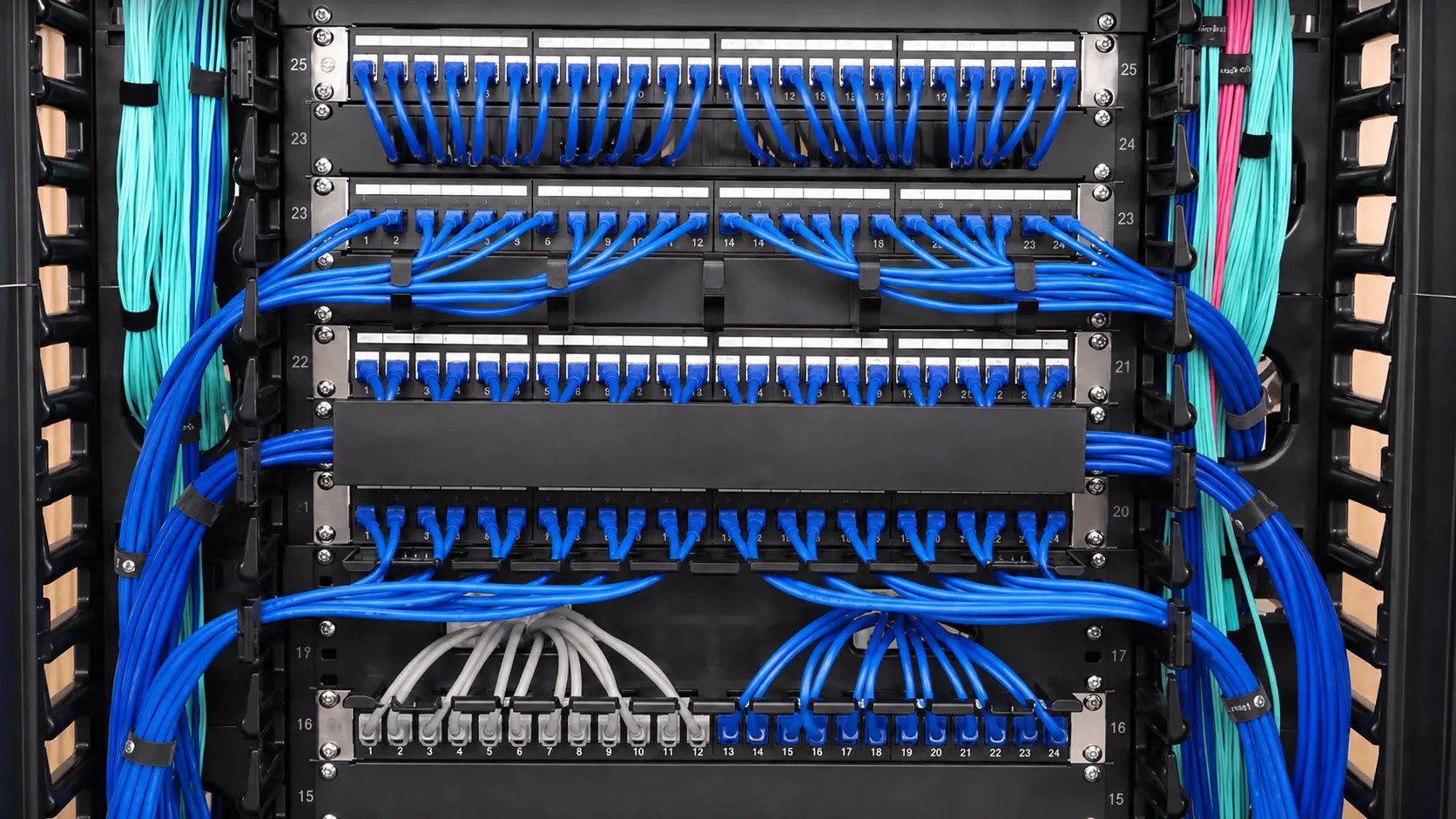
Network Cable Qualifier in Ethiopia
Before you spend on re-cabling, find out what your existing cable can actually carry. Seventech Solutions provides network cable qualification testing in Addis Ababa and across Ethiopia — confirming whether each link supports 1 Gigabit, 2.5G or 10 Gigabit Ethernet, verifying PoE delivery to cameras and access points, and locating faults to the metre.
- Bandwidth qualification: 10/100M, 1G, 2.5G, 5G and 10G
- PoE / PoE+ / PoE++ class detection and loaded voltage test
- TDR distance-to-fault, wire map and split-pair detection
- Same-day results — reuse good cable, replace only what fails
What Is Network Cable Qualification?
A network cable qualifier answers a practical question that building owners and IT managers ask constantly: will this cable actually run the speed I need? Rather than sweeping every frequency against a standards limit, a qualifier transmits real Ethernet traffic patterns down the link and reports which technologies it will reliably support — 10/100 Mbps, 1 Gigabit, 2.5G, 5G or 10 Gigabit Ethernet — alongside wire map, length, PoE capability and distance-to-fault.
It is the fastest, most economical way to assess cabling that is already installed. Across Addis Ababa, a great deal of serviceable Cat5e and Cat6 is ripped out every year on the assumption that it is too old — when qualification testing would have shown it carries Gigabit without complaint. Seventech Solutions tests first, so you only replace what genuinely needs replacing.
Do You Need a Qualifier or a Certifier?
These are two different jobs. Choosing the wrong one either wastes budget or leaves you without the documentation your consultant will demand.
Choose Qualification when…
- The cabling is already installed and you want to know what it supports
- You are planning a speed upgrade and need to know which runs can be reused
- Cameras or access points are dropping off and you suspect PoE or cable faults
- A user reports a slow or unstable port and you need a diagnosis today
- You want a fast, low-cost audit across many points before committing to spend
Deliverable: a per-port report of supported speeds, PoE results, lengths and faults.
Choose Certification when…
- You are handing over a new installation to a client or consultant
- A tender or contract requires testing to TIA-568 or ISO/IEC 11801
- You need to register a manufacturer’s system performance warranty
- There is a commercial dispute over whether cabling meets specification
- The design is Cat6A / 10G and every parameter must be formally proven
Not sure which applies? Describe the situation and we will tell you plainly — including when qualification alone is enough and certification would be an unnecessary expense.
Our Cable Qualification Services
Practical, fast-turnaround testing for cabling that is already in the wall.
Bandwidth & Speed Qualification
Every tested link is reported against the Ethernet technologies it will support — 10/100 Mbps, 1G, 2.5G, 5G and 10G. You get a clear reuse-or-replace decision per outlet instead of a blanket assumption about the whole building.
PoE Verification & Load Testing
We detect the PoE class a switch port is advertising, then apply a real load and measure voltage under that load — the only way to catch a link that negotiates PoE+ successfully but browns out when the camera’s IR illuminator engages.
Fault Location (TDR)
Opens, shorts, split pairs and crushed cable located to the metre using time-domain reflectometry, so a repair means opening one ceiling tile rather than chasing a run across a whole floor.
Switch Port & Link Diagnostics
We identify the switch, port number and VLAN a live outlet lands on, confirm negotiated speed and duplex, and flag mismatches — resolving the “it’s the cable” versus “it’s the switch” argument in minutes.
Pre-Upgrade Cabling Audit
Before a Wi-Fi 6/6E refresh, an IP camera rollout or a switch replacement, we qualify every relevant run and hand you a schedule showing exactly which points are ready and which need remediation — with costs attached.
Cable Tracing & Port Mapping
Unlabelled patch panels are the most common legacy problem we meet. We tone, trace and map every run back to its rack position, then label it properly so the next engineer does not start from zero.
What a Qualification Test Reports
Every point we qualify comes back with the same set of answers.
Testing is performed with current-generation handheld qualification testers suited to the cabling and the active equipment on site. Where a link needs formal standards-based proof rather than a speed verdict, we recommend certification instead and say so in the report.
When Qualification Testing Pays for Itself
Planning new cable rather than testing old? See our structured network cabling service, or read about standards-based certification testing for new installations and project handover.
How a Qualification Job Runs
Most sites are surveyed, tested and reported inside a single working week.
- 01
Define the Question
We agree what you actually need answered — “can this floor run 10G?”, “why do these four cameras reboot?”, “which of our 300 drops are reusable?” — and scope the test to that.
- 02
Access & Identification
Outlets and patch panel ports are traced and labelled where labelling is missing, so every result can be tied back to a physical location.
- 03
Qualification Testing
Each link is tested for supported speeds, wire map, length, fault distance and — where relevant — PoE class and loaded voltage, with results saved per port as we go.
- 04
Report with Recommendations
You receive a per-port schedule with a plain reuse / remediate / replace verdict, the faults we found and where they sit, plus a costed remediation option if you want us to fix them.
Network Cable Qualification — FAQ
What is a network cable qualifier?
A network cable qualifier is a handheld test instrument that determines which Ethernet speeds an installed cable link will reliably support. It sends real traffic patterns down the link and reports support for 10/100 Mbps, 1G, 2.5G, 5G and 10G, together with wire map, cable length, distance to any fault and PoE capability. It is designed for assessing and troubleshooting existing cabling quickly.
What is the difference between a cable qualifier and a cable certifier?
A qualifier tells you what speed a link will carry. A certifier tells you whether the link meets a published industry standard across every measured parameter. Qualification is faster and cheaper and is ideal for existing cabling, troubleshooting and upgrade planning. Certification is slower and more expensive but produces the formal, standards-based documentation required for project handover and manufacturer warranty registration. They complement each other rather than compete.
Can a qualifier replace certification for a new installation?
No. Qualification results are not accepted for warranty registration and will not satisfy a consultant or tender requirement that specifies TIA-568 or ISO/IEC 11801 compliance. If you are handing over new cabling, you need certification. If you are assessing cabling that is already in service, qualification is usually the right and more economical tool.
Can you test whether my existing Cat5e will run Gigabit?
Yes, and this is one of the most common requests we receive. Properly installed Cat5e within the distance limit will frequently support Gigabit Ethernet without any issue. Qualification testing tells you which of your runs do and which do not, so you replace a handful of problem links rather than re-cabling an entire floor on assumption.
Do you test PoE for cameras and access points?
Yes. We detect the PoE class the switch port advertises, confirm which pairs carry power, and apply a real load while measuring voltage. This catches the common failure where a link negotiates power successfully but the voltage drops below the device’s requirement once the camera or access point draws full current — the usual cause of devices that reboot at night or under load.
How much does cable qualification cost in Ethiopia?
Qualification is priced per point and is substantially cheaper than full certification, because the test is faster and the documentation is lighter. The rate depends on point count, site access and whether PoE load testing and tracing of unlabelled runs are included. Send us an approximate point count for a fixed written quotation.
Will testing disrupt our network or staff?
Minimally. Each port is offline only for the duration of its own test, typically seconds. We schedule work around your operating hours and can test in phases, floor by floor or department by department, so no area loses connectivity for long. For hotels and hospitals we routinely work overnight or in low-occupancy windows.
Do you qualify cabling outside Addis Ababa?
Yes. We are based in Addis Ababa and carry out qualification and audit work at regional sites throughout Ethiopia. Travel and accommodation for out-of-town projects is quoted transparently in advance, and we batch regional work where possible to keep mobilisation costs down.
Test Before You Replace
Tell us your point count and what you are planning to run over the cabling. We will quote a fixed per-point qualification survey and show you a sample report before you commit.