
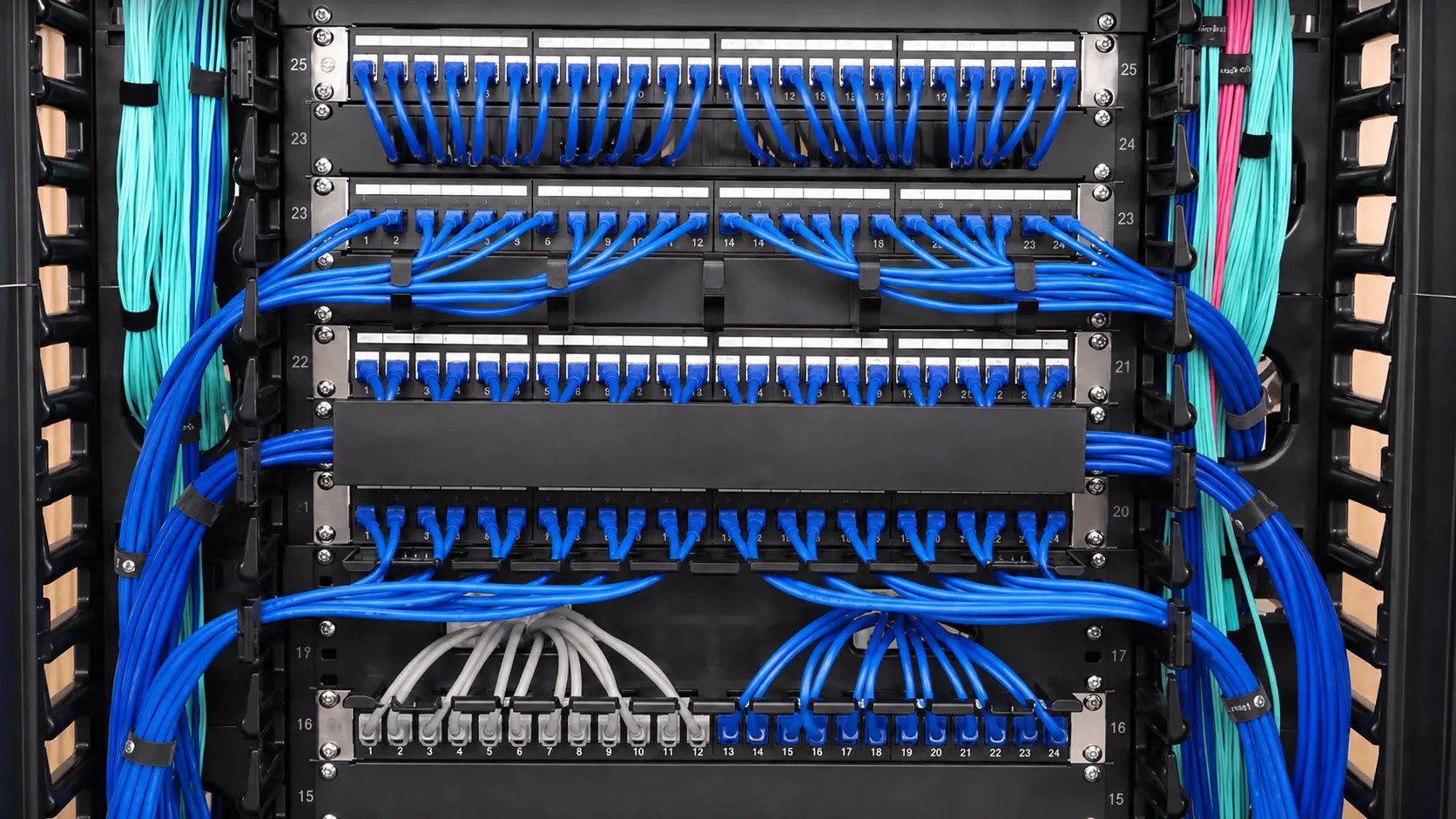
Network Cable Certifier in Ethiopia
Seventech Solutions provides professional network cable certification testing in Addis Ababa and across Ethiopia — copper and fiber links tested against TIA-568 and ISO/IEC 11801 limits, with a signed PDF certification report for every outlet. Prove your cabling performs before you hand over the site.
- Permanent Link & Channel testing to Cat6A / Class EA
- Tier 1 & Tier 2 (OTDR) fiber optic certification
- Per-port PASS/FAIL report, labelled and archived
- Independent third-party testing for contractor handover
What Is Network Cable Certification?
A network cable certifier is a precision test instrument that measures every electrical and optical parameter of an installed cabling link and compares the results against the published limits of an industry standard — TIA-568.2-D for copper, ISO/IEC 11801 for Class E/EA/F, and TIA-568.3-D for fiber optics. The result is a definitive PASS or FAIL verdict for each outlet, not an estimate.
In Ethiopia, most cabling disputes come down to one question: can the installer prove the link performs? Seventech Solutions provides independent, instrument-based certification so building owners, consultants and contractors in Addis Ababa have documented evidence that the structured cabling they paid for meets specification — and qualifies for a manufacturer’s performance warranty.
Verification vs. Qualification vs. Certification
Three different tools, three very different levels of proof. Only one of them is accepted for warranty registration and project handover.
| Test Level | Typical Tool | What It Proves | Accepted for Handover? |
|---|---|---|---|
| Verification | Continuity / wire-map tester | Pins are connected in the right order and nothing is open, shorted or split. | No |
| Qualification | Qualifier (e.g. network speed tester) | The link will carry a given speed — 1G or 10G — today, on this device. | No |
| Certification | Certifier (Level III/IV/V accuracy) | Every TIA/ISO parameter — NEXT, ACR-F, return loss, insertion loss, delay skew — is within standard limits across the full frequency sweep. | Yes |
What We Certify
Copper and fiber, from a ten-point office fit-out to a multi-floor campus backbone.
Copper Permanent Link Certification
Cat5e, Cat6 and Cat6A horizontal links tested outlet-to-patch-panel against TIA-568.2-D and ISO/IEC 11801 Class D/E/EA limits — wire map, length, insertion loss, NEXT, PS-NEXT, ACR-F, return loss, propagation delay and delay skew.
Fiber Optic Tier 1 & Tier 2
Tier 1 loss/length certification with an optical loss test set, plus Tier 2 OTDR traces that locate every splice, connector and bend on singlemode and multimode backbones — the evidence you need before a fiber link is accepted.
Data Centre & Rack Backbone
Channel testing of patch-cord-to-patch-cord paths, trunk and MPO cassette verification, and polarity checking for server room and data centre deployments where a marginal link becomes an outage.
Third-Party Acceptance Testing
Independent certification of cabling installed by another contractor. We test, document and report without a stake in the installation — the standard approach for consultants and project owners validating a handover.
Fault Finding & Remediation
When a link fails, the certifier tells us where. We locate split pairs, crushed cable, excessive untwist, bad terminations and length faults to the metre, repair them, and re-test until the link certifies clean.
Documentation & As-Built Records
Labelling to TIA-606, a per-port PASS/FAIL report, the native test database, and an as-built schedule mapping every outlet to its rack, patch panel and port. Handed over as PDF and raw data.
The Parameters a Certifier Measures
A certification report is only meaningful if you know what was measured. Here is what appears on every copper link we certify.
Testing is performed with calibrated, field-grade certifiers appropriate to the class of cabling being certified, with calibration traceable and in date at the time of test. Calibration certificates are available on request.
How a Certification Job Runs
From first call to signed report — a typical 200-point office certifies in two to three working days.
- 01
Scope & Site Survey
We confirm point count, cable category, topology and the standard you need to certify against, then quote per point with no hidden mobilisation charges.
- 02
Labelling & Identification
Every outlet, patch panel port and backbone strand is labelled to a consistent TIA-606 scheme so the test record matches the physical plant.
- 03
Certification Testing
Permanent Link or Channel tests are run on every point with the correct adapters and a current calibration, and results are stored in the tester’s database as they are taken.
- 04
Fault Resolution
Failed links are diagnosed on the spot, repaired, and re-tested. No link leaves the site with a marginal or FAIL* verdict.
- 05
Report & Handover
You receive a signed PDF certification report, the raw test database, an as-built port schedule, and — where the components qualify — support with manufacturer warranty registration.
Who Needs Cable Certification in Ethiopia
Already planning the install? See our structured network cabling and data centre & server room design services, or talk to us about certifying cabling that is already in the ground.
Network Cable Certification — FAQ
What is a network cable certifier?
A network cable certifier is a calibrated field test instrument that sweeps an installed copper or fiber link across its full frequency or wavelength range, measures every parameter defined by TIA-568 or ISO/IEC 11801, and returns a PASS or FAIL verdict against those limits. Unlike a continuity tester or a qualifier, it produces documentation that manufacturers accept for warranty registration and that consultants accept for project handover.
How much does network cable certification cost in Ethiopia?
Certification is normally priced per point, and the rate depends on cable category, total point count, site access and whether fiber Tier 2 testing is included. Larger projects attract a lower per-point rate. Send us your point schedule or floor plan and we will return a fixed written quotation — we do not charge for the survey.
What is the difference between Permanent Link and Channel testing?
Permanent Link tests the fixed cabling only — from the wall outlet to the patch panel, excluding patch cords. Channel testing includes the patch cords at both ends, reflecting what the active equipment actually sees. Permanent Link is the standard test for acceptance of a new installation; Channel is used when diagnosing a live link or validating an end-to-end path in a rack.
Can you certify cabling installed by another contractor?
Yes. Independent third-party acceptance testing is one of the most common reasons clients engage us. We test what is installed, report exactly what the instrument measured, and provide the evidence — whether the links pass or fail. Where links fail, we can quote separately on remediation.
Why did my Cat6 cable fail certification?
The most common causes are excessive untwisting of pairs at the termination, cable crushed by over-tightened ties or a tight bend radius, links exceeding the 90 metre permanent link limit, mixing components from different performance categories, and poor-quality or counterfeit cable that does not meet its printed specification. A certifier identifies which parameter failed and at what distance, so the fault can be fixed rather than guessed at.
Do I get a certificate I can give to my client or consultant?
Yes. Every project is delivered with a signed PDF report showing per-port results, the standard tested against, the tester model and its calibration date, plus the raw test database file and an as-built port schedule. Where the installed components qualify, we also assist with registering the manufacturer’s system performance warranty.
How long does certification take?
Testing itself is fast — a trained engineer certifies a copper permanent link in well under a minute. Most of the schedule goes into labelling, access and documentation. As a guide, a clean, fully labelled 200-point office typically certifies in two to three working days, including the report.
Do you provide certification outside Addis Ababa?
Yes. We are based in Addis Ababa and carry out certification projects at regional sites across Ethiopia. Travel and accommodation for out-of-town work is quoted transparently up front, and we schedule regional projects to minimise mobilisation cost.
Prove Your Cabling Performs
Send us your point schedule and we will return a fixed, per-point certification quotation — plus a sample report so you know exactly what you are buying.